Showing posts with label fiction. Show all posts

Wednesday, 18 February 2015

Memories and Memorials (2) | Life Stories

A couple of years ago I read The Five People You Meet in Heaven by Mitch Albom which is a novel which does want it says on the tin; the five people not necessarily being the ones the hero of the book was closest to but the five most significant in terms of life chances and experiences. When he meets his wife she says:

Lost love is still love Eddie. It takes a different form, that’s all. You can’t see their smile or bring them food or tousle their hair or move them around a dance floor. But when those senses weaken, another heightens. Memory. Memory becomes your partner. You nurture it. You hold it. You dance with it (Albom 2003: 184-185).

I don’t see Five People as a religious novel, and it’s certainly not denominational. Additionally, it is much more about Eddie’s life and the (often lasting) impact he had on other people and the impact they had on him, than about this death or any afterlife.  

I often read novels where death is a theme and find them as enjoyable and rewarding as a good love story or mystery. As many writers have argued fiction affects its’ readers at an immediate and an emotional level. So much so that alongside more traditional representations such as reports and verbal presentations researchers in the humanities and social sciences now sometimes use the genre of fiction (and other arts based approaches) to share research stories within and beyond the academy.  My own readings tastes, like those of many people, are eclectic and although I don’t just read fiction like Brenda Walker (2010) I find I am able to escape into and find comfort especially in this form of writing. Walker’s book is called Reading by Moonlight: how books saved a life and in it she writes about how she turned to books, to literature, to reading as well as to medicine following a cancer diagnosis. This bookcase is in my hall, opposite the loo. It’s packed with novels, academic texts (including some I’ve written or edited myself), some coffee table type publications and one poetry book. The other several bookcases in my flat contain a similar mix. There are (auto)biographies too.

Steph Lawler (2008) reminds us that although few of us will formally write an autobiography we all engage in autobiographical work every day. So we write letters, we complete job applications, we keep diaries and write things on calendars and we talk about ourselves with others all the time. Robert Zussman (2005) uses the term ‘autobiographical occasions’ to refer to the times we are encouraged or required to provide accounts of ourselves. The use of the word occasions may suggest a rare, or at least not regular, occurrence whereas autobiographical practice is in fact a constant aspect of life.

We don’t just tell stories about ourselves of course but also stories of others; friends, family members, acquaintances, work-mates, individuals – living or dead – who we admire. Although the deceased may have had some input into the construction of their obituary and eulogy before they died much and most of these are written by others. Drawing on the memories of those significant in the personal and professional life of the person who has died these ‘(auto)biographical occasions’ provide an opportunity to praise and commemorate a life, to paint a picture of a person’s personality, to share some of their favourite concerns and interests and to acknowledge the impact of their lives on others. Such writings, alongside other memorials, highlight the ways in which a person who is biologically dead continues to have an active social presence and influence in the lives of the living.


Albon, Mitch (2003) The Five People You Meet in Heaven London: Shere

Lawler, Steph (2008) Identity: sociological perspectives Cambridge: Polity

Walker, Brenda (2010) Reading by Moonlight: how books saved a life Victoria, Australia: Hamish Hamilton (Penguin)

Zussman, Robert (2000) ‘Autobiographical Occasions: Introduction to the Special Issue’ Qualitative Sociology - Special Issue: Autobiographical Occasions 23(1): 5-8

Wednesday, 24 December 2014

Bereavement and Creativity (1) | Painting, Writing and Other Creative Endeavours


When someone close to us dies our everyday world is disrupted and we need to find ways not only to cope with our loss and the associated grief that we feel but also with not having that person in our lives on a day-to-day basis any more. It is increasingly acknowledged by grief counsellors, therapists and scholars concerned with death and bereavement that there is a place for creativity – including the production and presentations of music, visual arts, stories and poems, drama and so on - within bereavement. Such activity is thought to be one result of and to assist individuals through the grieving process. The production of online memorials is a fairly recent way of collecting together and displaying such materials although grief related creations have been produced and documented throughout history. Some examples of the artefacts, images and other outputs produced and the value of such production are considered by the authors in a special edition of the journal Illness, Crisis and Loss http://www.baywood.com/journals/previewjournals.asp?Id=1054-1373 that my friend Deborah Davidson (from York University, Ontario) and I are currently editing (due to be published in 2015).The fruits of such activity can be useful not only for the person who produces the piece(s) but also for others. We know, for example, that music and fiction enables listeners and readers to experience emotions — their own and those of others — and understand them in relation to the contexts in which the emotions arise. Similar can be said about art and drama. For many grief is a long process and the making of ‘things’ in memory of those who have died and/or as a way of expressing emotions along the way is helpful for some.
Memorial . . . by numbers

During my own grief journeys I have experimented with different types of creativity. I still have the picture I painted following my miscarriage in the mid-1980s. Not much skill or even originality displayed here as this artwork is in fact the result of a ‘painting by numbers’ kit but for me this piece is priceless.

More recently following the death of my husband and my mum I have written a number of (short and not so short) pieces of fiction; some of which are clearly related to my own life, some less so. Prior to 2010 I had not written this way since childhood although I had always hoped to follow my dad who had some success at publishing short stories in the 1960s. All of a sudden I had some ideas. Thus far I have had a few short stories published both online and as part of my academic sociological writings on relationships and on loss. Earlier this month my first (and I hope not my last) ‘paper’ success was published in a collection following the annual women’s fiction competition by the Hysterectomy Association http://shop.hysterectomy-association.org.uk/hysteria-3/


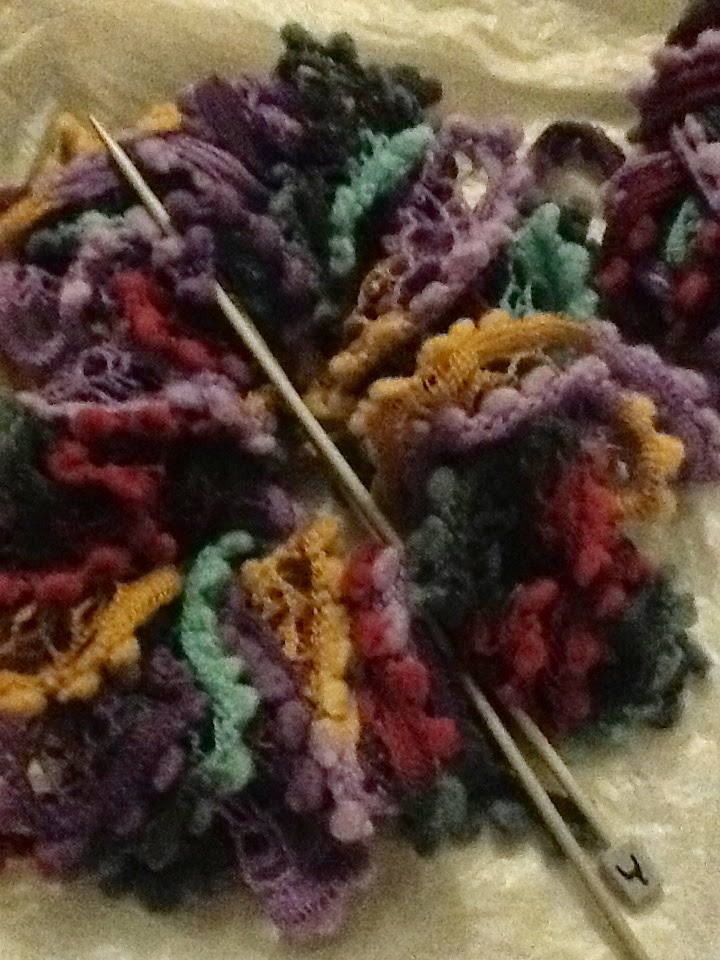
In addition to these experiments with art and writing I also find knitting
therapeutic and fun and I enjoy the pleasure that friends express when 
I present them with the scarves and other small garments that I 
have produced.

 
A scarf in progress
I share these personal examples
not in any way as ideals or
exemplars but to illustrate that 
any of us, maybe all of us,
whether we consider ourselves
to be artistic or not, 
can find comfort, pleasure
and a sense of achievement
in such work.